
Rome's "Great Mosaic" is a first-century AD wall mosaic, roughly 10 meters high and 16 meters long, found beneath the Oppian Hill near the Colosseum and opened to the public in September 2026. Archaeologists working on the site estimate it may be the biggest wall mosaic ever found in the Roman world. For anyone who loves mosaic art, it is a rare look at how Roman artisans worked at monumental scale.
At iMosaicArt, a US-based maker of handmade marble and glass mosaic art, we spend every day setting stone and glass by hand, so a discovery like this feels personal. Below we cover what was found, what remains uncertain, and the Roman techniques that still guide our studio's work.
Key Takeaways
- The Great Mosaic dates to the 1st century AD and was found in an underground gallery on Rome's Oppian Hill, close to the Colosseum.
- It was first uncovered during excavations of the Baths of Trajan in the 1990s, then restored and opened to visitors in September 2026 alongside the 'Painted City' fresco.
- Reported dimensions are about 10 m high by 16 m long; the excavation team estimates it is the largest Roman wall mosaic known.
- Researchers have not settled whether it belonged to Nero's Domus Aurea palace or to a private house later absorbed into it.
- Roman mosaic methods — cut tesserae, layered mortar beds and the opus vermiculatum technique — are still used in handmade mosaics today.
What is the Great Mosaic of the Oppian Hill?
The Great Mosaic is a large figurative wall mosaic preserved in an underground gallery beneath the Oppian Hill, one of Rome's seven hills. It sits in the area later covered by the Baths of Trajan, a short walk from the Colosseum. News reports describe scenes that include a bearded philosopher, a centaur and a young poet receiving a laurel crown.
It was opened to the public together with the nearby "Painted City" fresco, a first-century painting of a walled maritime city with streets, doors and theaters, as part of a new museum space at the Baths of Trajan.
How big is it, and is it really the largest?
CNN reported the mosaic as about 10 meters (33 feet) high and 16 meters (52 feet) long; Euronews described a 15-meter section, so published figures differ slightly. Archaeologist Francesco Pacetti told reporters, "We estimate that it is the biggest wall mosaic ever found in the Roman world." That is the excavation team's estimate rather than an independent ranking, but even by conservative measures it is an exceptional survival.
Was it part of Nero's Golden House?
Not certainly. The Oppian Hill holds the remains of the Domus Aurea, the vast palace Emperor Nero built after the fire of 64 AD. Archaeologists have said it is still unclear whether the mosaic was made for Nero's palace or for a separate private residence that Nero later absorbed. Either way, it was commissioned by someone with great wealth: wall mosaics of this size were among the most expensive decorations a Roman patron could buy.
Why were wall mosaics so rare in ancient Rome?
Most surviving Roman mosaics are floors. Floors were built to bear weight and were often buried under later construction, which protected them. Wall and vault mosaics, by contrast, usually fell when buildings collapsed or were stripped for materials. They also often used glass tesserae, which were costlier than stone. A wall mosaic surviving at this scale is therefore unusual.

Source: The Birth Of Venus Mosaic By Botticelli - Roman Mosaic Reproduction by iMosaicArt
Which Roman mosaic techniques are still used today?
Three Roman methods remain the foundation of handmade mosaic art:
- Opus tessellatum — regular, roughly square tesserae laid in even rows, ideal for borders, backgrounds and geometric patterns.
- Opus vermiculatum — very small tesserae following the contours of a figure, which lets an artist shade faces, fabric and animals like a painting.
- Opus sectile — larger pieces of stone cut to shape, used for bold inlay designs.
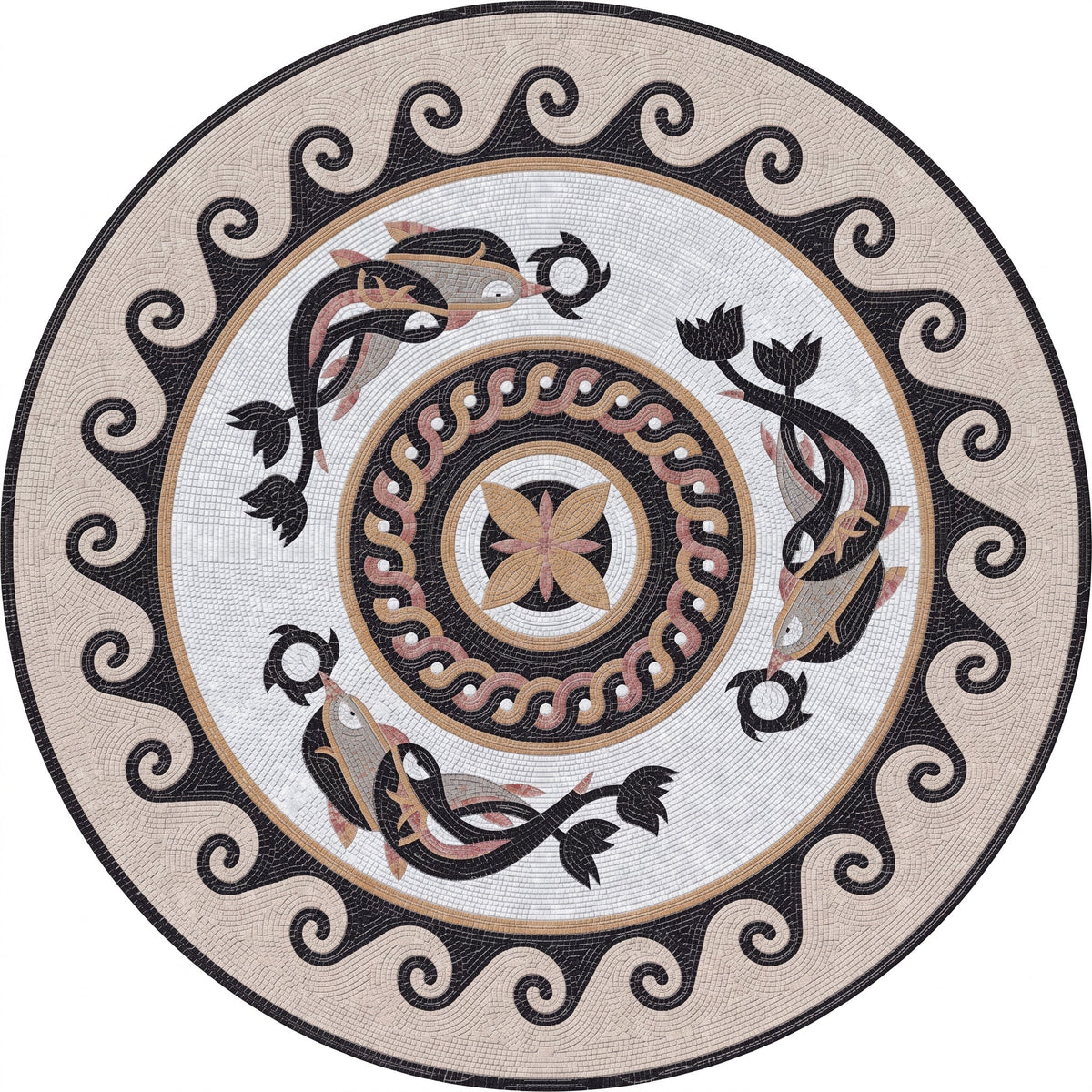
Our Roman mosaic collection uses the same vocabulary: hand-cut natural marble in tessellatum backgrounds, with vermiculatum detail for figures. Pieces such as the Roman Dolphin Wave Medallion draw directly on the marine motifs that decorated Roman baths and villas.

Source: iMosaicArt portfolio · Shop Roman mosaics
Other notable mosaic finds in 2026
- Zile, Tokat, Türkiye (May 2026): second-century AD floor mosaics featuring a female figure with Greek inscriptions meaning "luxury" and "abundance", reported by Archaeology Magazine.
- Pompeiopolis, Kastamonu, Türkiye (September 2026): around 105 square meters of 4th-century AD floor mosaics uncovered during ongoing excavations.
How to bring the Roman look into a modern home
You do not need a palace to enjoy Roman-style mosaic. A marble floor medallion in an entryway, a mythological scene above a fireplace or a classical border around a kitchen backsplash brings the same sense of permanence. Natural marble tones — cream, terracotta, slate and ochre — work in both traditional and contemporary interiors. If you have a specific scene in mind, our custom mosaic service can adapt classical designs to your dimensions and palette.
Ready to bring this idea home? Explore iMosaicArt's full catalog of handmade mosaics, see a featured piece like Starry Night Glass Mosaic Reproduction, browse real installations in our portfolio, or commission a custom mosaic made to your size.
Frequently Asked Questions
Where is the Great Mosaic in Rome?
It is in an underground gallery beneath the Oppian Hill, within the area of the Baths of Trajan, a short walk from the Colosseum.
How old is the Great Mosaic?
It dates to the 1st century AD, roughly the era of Emperor Nero.
When was the Great Mosaic discovered?
It was first uncovered during excavations of the Baths of Trajan in the 1990s and was restored and opened to the public in September 2026.
What is the difference between a Roman floor mosaic and a wall mosaic?
Floor mosaics usually used durable stone tesserae laid to bear foot traffic, while wall and vault mosaics more often used colorful glass tesserae and survive far less often.
Can I buy a Roman-style mosaic today?
Yes. Handmade marble mosaics in the Roman tradition, such as those in the iMosaicArt Roman collection, use the same cut-stone techniques and can be made to custom sizes.
Keep exploring
- The history of mosaic art
- Advanced mosaic techniques: opus vermiculatum and micro mosaic
- Gaudí's mosaic artistry at the Sagrada Familia